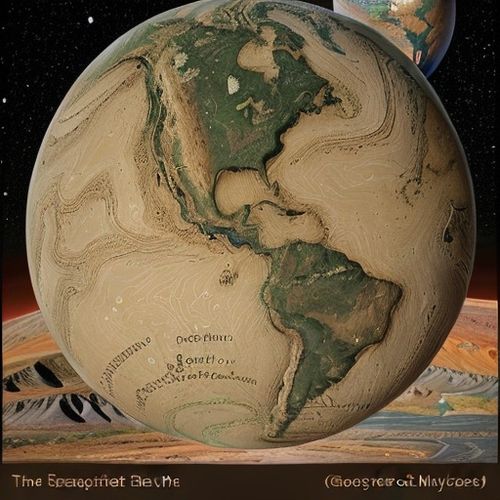
The Earth beneath our feet holds mysteries that have captivated scientists for centuries. Geophysics, the study of Earth's physical properties and processes, provides us with tools to unravel these mysteries without digging deeper than necessary. This field sits at the fascinating intersection of physics, geology, and mathematics, offering insights into everything from earthquake prediction to mineral exploration.
Understanding Our Planet's Hidden Layers
Modern geophysics allows us to peer deep into Earth's structure without direct observation. Through seismic wave analysis, researchers have mapped the planet's internal layers with remarkable precision. When earthquakes occur, they generate waves that travel through Earth's interior at speeds determined by the materials they encounter. By measuring these waves at different surface locations, geophysicists can reconstruct detailed images of our planet's interior architecture.
The classic model of Earth's structure - crust, mantle, outer core, and inner core - owes its existence to geophysical investigations. The crust varies significantly, from about 5-10 km thick beneath oceans to 30-50 km under continents. Below this lies the mantle, extending nearly 2,900 km downward. The outer core, a liquid iron-nickel alloy, creates Earth's magnetic field through dynamo action, while the solid inner core spins slightly faster than the rest of the planet.
The Tools That Reveal Earth's Secrets
Geophysicists employ an arsenal of sophisticated instruments to probe Earth's subsurface. Seismographs form the backbone of earthquake monitoring networks, capable of detecting ground motions smaller than the width of a human hair. Gravity meters measure subtle variations in Earth's gravitational field that hint at underground density differences. Magnetometers chart magnetic anomalies that might indicate mineral deposits or archaeological features.
Ground-penetrating radar sends high-frequency radio waves into the ground, revealing shallow structures with centimeter-scale resolution. Electrical resistivity tomography injects current into the ground to map subsurface conductivity variations. These non-invasive techniques have revolutionized our ability to study Earth while minimizing environmental disturbance.
Earthquake Science and Hazard Mitigation
Perhaps the most visible application of geophysics lies in earthquake studies. The development of plate tectonic theory in the 1960s provided the framework for understanding why earthquakes occur where they do. Most quakes happen along plate boundaries, where enormous slabs of Earth's lithosphere grind past, collide with, or dive beneath one another.
Geophysicists now monitor fault zones with networks of GPS stations that detect millimeter-scale ground movements. Strain meters measure how rocks deform under tectonic stress. While earthquake prediction remains elusive, these measurements help assess seismic hazards and inform building codes. The 2011 Tohoku earthquake in Japan demonstrated both the power of modern monitoring systems and the challenges of anticipating megaquakes.
Resource Exploration and Environmental Applications
The energy industry relies heavily on geophysical methods to locate oil, gas, and mineral deposits. Seismic reflection surveys, where sound waves are bounced off underground layers, create detailed images of sedimentary basins that might contain hydrocarbons. These techniques have become increasingly sophisticated, with 3D and even 4D (time-lapse) seismic imaging now common in major oil fields.
Environmental geophysics helps address pressing ecological challenges. Electrical methods track groundwater contamination plumes. Seismic techniques assess landslide risks. Ground-penetrating radar locates buried waste without excavation. As climate change accelerates, geophysical monitoring of permafrost thaw and glacier retreat provides crucial data for climate models.
Planetary Geophysics and Comparative Studies
The methods developed for studying Earth now help us understand other worlds. Seismometers placed on the Moon during Apollo missions revealed its internal structure. The InSight lander's seismometer detected marsquakes, showing Mars to be more geologically active than expected. Gravity measurements from orbiting spacecraft map the subsurface oceans of icy moons like Europa.
Comparing Earth to other planets yields insights into our own world's uniqueness and history. Venus's lack of plate tectonics despite similar size to Earth remains a puzzle. Jupiter's moon Io, the most volcanically active body in the solar system, offers extreme examples of tidal heating processes that may have operated on early Earth.
Future Frontiers in Geophysical Research
Emerging technologies promise to revolutionize geophysics. Distributed acoustic sensing uses fiber-optic cables as dense seismic arrays, turning existing telecommunications infrastructure into earthquake detectors. Machine learning algorithms parse enormous geophysical datasets, identifying subtle patterns human analysts might miss. Quantum gravity gradiometers could someday detect underground voids or ore bodies with unprecedented precision.
Deep Earth imaging remains a grand challenge. While we've mapped the core-mantle boundary, details of mantle convection - the slow churning that drives plate tectonics - remain fuzzy. New computational methods and international collaborations like the EarthScope project continue to refine our picture of Earth's interior dynamics.
As climate change alters our planet's surface, geophysical monitoring becomes ever more crucial. Thawing permafrost releases greenhouse gases in feedback loops. Changing water tables affect seismic hazard assessments. Melting ice sheets alter Earth's shape and gravity field. Geophysicists will play key roles in understanding and mitigating these changes.
The field continues to evolve, blending traditional field observations with cutting-edge technology and computational modeling. From predicting volcanic eruptions to locating critical minerals for renewable energy technologies, geophysics remains essential for navigating humanity's future on this dynamic planet we call home.
By Thomas Roberts/Apr 19, 2025

By Amanda Phillips/Apr 19, 2025
By Daniel Scott/Apr 19, 2025
By Christopher Harris/Apr 19, 2025

By David Anderson/Apr 19, 2025
By Amanda Phillips/Apr 19, 2025
By Ryan Martin/Apr 19, 2025

By Jessica Lee/Apr 19, 2025

By Eric Ward/Apr 19, 2025
By Megan Clark/Apr 19, 2025

By Michael Brown/Apr 19, 2025
By Jessica Lee/Apr 19, 2025
By Laura Wilson/Apr 19, 2025
By Jessica Lee/Apr 19, 2025
By Emma Thompson/Apr 19, 2025

By Elizabeth Taylor/Apr 19, 2025

By Jessica Lee/Apr 19, 2025
By Elizabeth Taylor/Apr 19, 2025
By Lily Simpson/Apr 19, 2025

By Michael Brown/Apr 19, 2025